How to interpret the result, what mitigation actually involves, how to choose the right certified provider, and how to verify the final outcome.
Reading an elevated result without drama
First reflex: put the number in context. Your long-term reading compares against Health Canada’s Canadian reference, whose exact value must be validated on the official dated source. That benchmark exists precisely to rank situations: the further above the reference, the higher the correction’s priority.
Second reflex: remember exposure plays out over years. A few extra weeks spent planning the work properly changes nothing about the picture, while a rushed decision (wrong provider, poorly designed system), can cost twice.
Third reflex: keep in mind this problem has a standard solution. Mitigation techniques are documented, taught and field-proven over decades. You are neither the first nor the last owner in this situation, and the vast majority of homes fix up well.
What mitigation actually involves
In most Quebec homes with concrete foundations, the dominant technique is sub-slab depressurization: a slight vacuum is created under the foundation using a pipe and fan that push the gas outside before it gets a chance to enter.
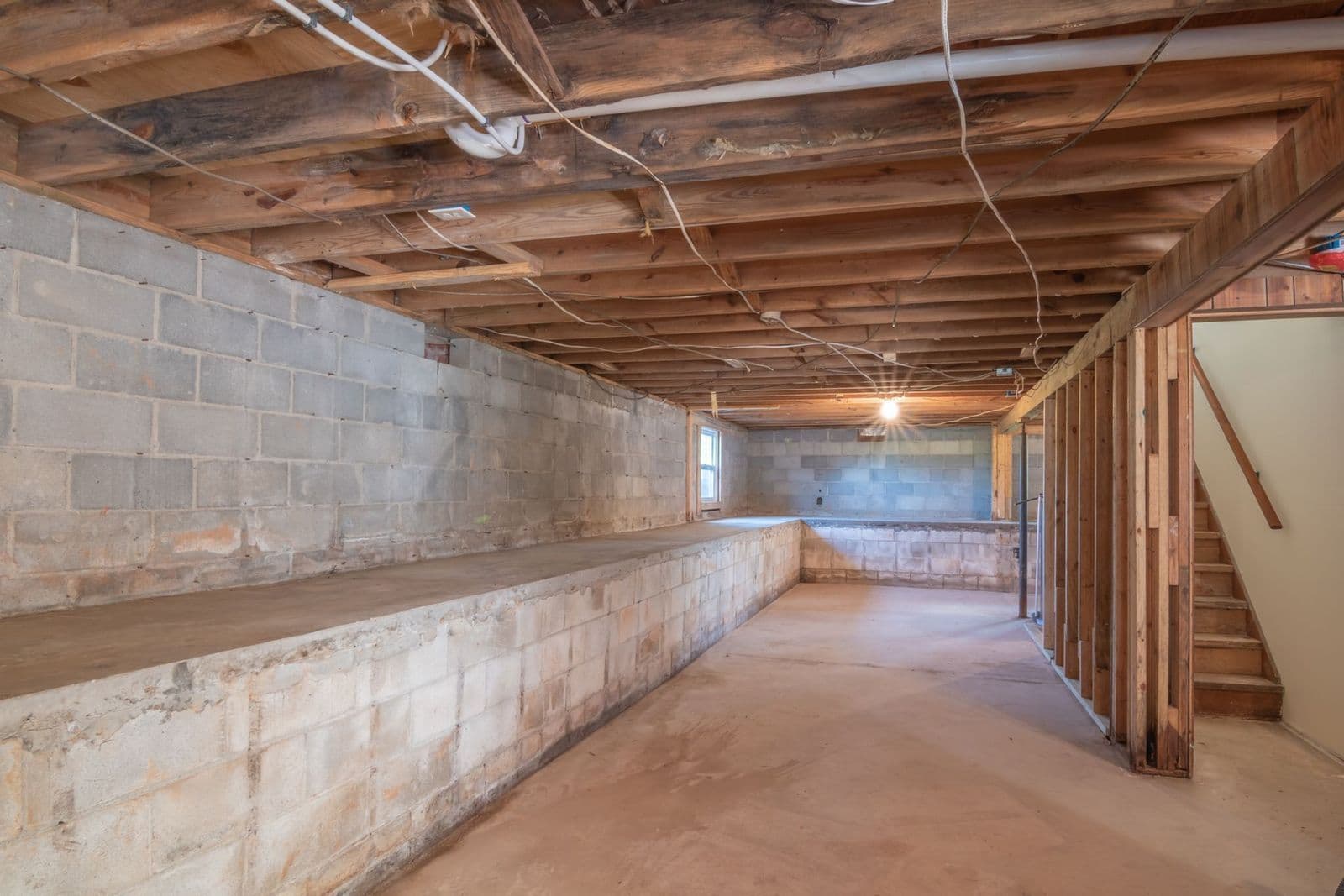
Depending on the layout (multiple slabs, crawl space, stone foundation, unusual drainage), the professional may combine approaches: sealing significant openings, managing the sump, adjusting the system. Every house dictates its own logic, hence the upfront inspection.
Day to day, a well-installed system stays discreet: a tube running along an exterior wall and a quiet fan, often at the roofline or rear façade. Some systems include a visual operating indicator; if not, ask for one in the quote.
Choosing the right person for the job
Mitigation requires specific skills: reading a foundation, sizing a system, sealing correctly, verifying the achieved depression. Insist on someone holding a recognized mitigation certification (for example C-NRPP or an equivalent), and do not hesitate to ask for the certificate number.
Compare at least two written proposals. Each should detail the intended technique, system location, planned sealings, offered warranties and the confirmation retest. A quote that boils down to a price without a method deserves your suspicion.
One important nuance: testing and mitigation are two distinct skills. Some providers hold both certifications, others only one. Explicitly ask which one covers each stage, and keep your original test reports so the before/after comparison stands on the same footing.
Verifying it truly works afterwards
Mitigation passes one test only: the new radon level. After installation and stabilization, a long-term retest (same rules as the first time, lowest occupied level, comparable season), confirms the drop.
Some professionals include this verification in their offer; others bill it separately. Either way, write it into your plan from the start: without it, you cannot tell whether the system brings the annual average back under the 200 Bq/m³ guideline.
Once confirmed, the system asks little: an occasional look at the fan and operating indicator, plus a retest after any major change to the foundation or drainage. Record the installation date and keep the paperwork with the home’s files.
Verified and sourced
Verified on September 27, 2026
Official sources
What these numbers do not cover
An annual average above the 200 Bq/m³ guideline is addressed first through ventilation and sealing, then through the cost of the work, which is not priced here; verification requires a new long-term test of at least three months.